
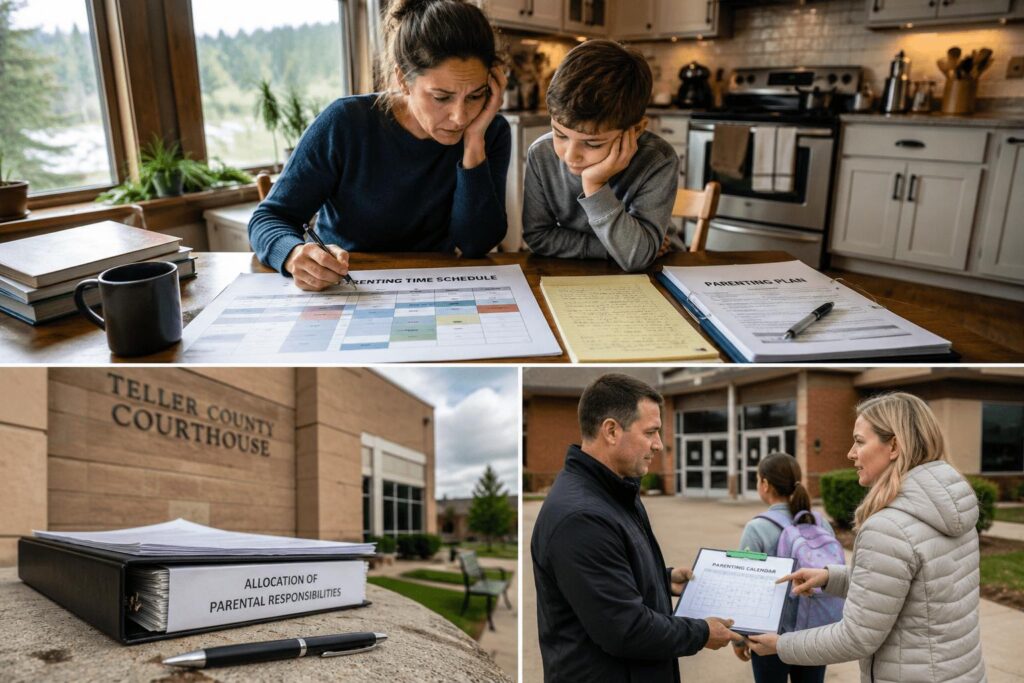
WHEN PARENTING ORDERS MATTER, THE DETAILS MATTER TOO
Parental responsibility cases can affect your daily routine, your child’s school life, your ability to make major decisions, and the way your family moves forward after separation, divorce, or conflict between parents. If you are in Woodland Park or elsewhere in Teller County, these cases often involve more than a standard parenting schedule. They can involve mountain travel, school logistics, safety concerns, work schedules, and communication problems that require careful handling.
Colorado no longer uses the word “custody” as the main legal term in most family law cases. Instead, the court uses “allocation of parental responsibilities,” often shortened to APR. That phrase includes parenting time, decision-making responsibility, and related orders that help define each parent’s role in the child’s life.
This article explains what parental responsibilities mean in Colorado, how APR cases arise in Woodland Park and Teller County, what Moran, Allen & Associates Family Law can help parents evaluate, what evidence may matter, and what practical steps you can take before mediation or court. This information is general education, not legal advice for your specific situation. Your case should be reviewed directly with an attorney who can evaluate your facts, documents, deadlines, and court orders.
WHAT IS ALLOCATION OF PARENTAL RESPONSIBILITIES IN COLORADO?
Allocation of parental responsibilities is Colorado’s legal term for the rights and duties parents have for their children after separation, divorce, or a court case involving parenting issues. It usually includes two major parts: parenting time and decision-making responsibility. Parenting time is the schedule, while decision-making responsibility is authority over major choices for the child.
Parenting time can include regular weekly time, weekends, holidays, school breaks, vacations, transportation, exchanges, phone contact, and make-up time. Decision-making responsibility can include education, medical care, mental health care, religion, and other major issues affecting the child’s welfare. A complete parenting plan should clearly explain both parts.
Colorado courts decide parental responsibilities based on the child’s best interests. The state statute on the best interests of the child addresses allocation of parental responsibilities. It focuses on the child’s safety, emotional needs, physical needs, relationships, stability, and other legally relevant factors. A strong APR case usually depends on specific facts, organized evidence, and a parenting plan that fits the child’s real life.
PLAIN-ENGLISH OVERVIEW OF PARENTAL RESPONSIBILITIES IN TELLER COUNTY
Parental responsibilities are not just legal labels. They are the rules that shape how parents share time, make decisions, exchange information, and handle disagreements about their child. When those rules are vague, conflict often increases.
In Teller County, the practical side of parental responsibilities can matter a great deal. A parenting plan that looks balanced on paper may not work if one parent lives in Woodland Park, the other works in Colorado Springs, and the child has early school start times, winter travel concerns, or regular medical appointments outside the county. A good APR plan should connect the legal standard to the child’s daily routine.
The Colorado Judicial Branch provides official information and forms for parenting plan and APR cases. Those resources are useful, but forms alone do not resolve the harder questions, such as how to structure exchanges, how to handle joint decisions, how to address safety concerns, and how to create orders that are clear enough to enforce.
WHAT DOES A PARENTAL RESPONSIBILITIES ATTORNEY DO?
A parental responsibilities attorney helps parents understand, negotiate, and litigate issues involving parenting time and decision-making responsibility, while providing strong legal representation when disputes become difficult. That may include creating a proposed parenting plan, reviewing evidence, preparing for mediation, responding to court filings, addressing child support overlap, and presenting unresolved issues at a hearing. The attorney’s role is to help turn family conflict into legally relevant facts and practical proposed orders.
In an APR case, a lawyer may review school records, medical records, communication between parents, work schedules, childcare needs, prior parenting patterns, safety concerns, and transportation realities. The lawyer may also help determine whether a request is realistic, supported by evidence, and likely to reduce or increase future conflict. This is especially important when parents disagree about school choice, relocation, medical decisions, or supervision, and when the case involves relocation-related complications or tax issues affecting parenting and support.
A parental responsibility attorney should also help you avoid preventable mistakes. That can include avoiding vague parenting language, missing deadlines, relying on informal agreements, withholding parenting time without legal guidance, or sending emotional messages that may later be used in court. The goal is not to make the case more complicated. The goal is to make the case clearer, better documented, and more focused on the child.
HOW MORAN, ALLEN & ASSOCIATES APPROACHES APR CASES
Moran, Allen & Associates Family Law approaches parental responsibilities cases with a practical focus on the child’s real needs and the family’s actual circumstances. The firm is committed to pursuing the best outcome through a strategic approach tailored to the family’s circumstances. That means looking beyond labels like “primary parent” or “equal time” and asking what schedule, decision-making structure, and communication rules will work for this child and these parents. The firm’s family law services page outlines family law matters that often overlap with APR disputes.
In many cases, the first step is identifying the issues that truly need court attention in a legal matter. Some disputes are about the regular schedule. Others are about school, medical decisions, safety, communication, transportation, relocation, or repeated violations of an existing order. A careful review can help separate urgent issues from issues that may be handled through negotiation or mediation.
The firm’s legal team takes an evidence-focused approach. A parent’s concerns may be valid, but the court generally needs specific information. Parenting calendars, school records, medical information, messages, incident timelines, and prior orders can often say more than broad accusations or emotional descriptions. An attorney well-versed in Teller County family courts also understands local judicial preferences.
WHY LOCAL TELLER COUNTY EXPERIENCE MATTERS
Family law is governed by Colorado law, but cases happen in real communities. Woodland Park and Teller County families may deal with long commutes, mountain roads, winter weather, small-school dynamics, seasonal work, and exchanges that involve travel between counties. These details can affect whether a proposed parenting plan is realistic.
Local experience also matters because family law orders need to be lived with after court. A schedule may technically divide time fairly, but still be hard on a child if it requires frequent long drives on school mornings. A decision-making order may sound cooperative, but it may fail if the parents cannot communicate safely or consistently.
An attorney familiar with Teller County and the broader Pikes Peak region can better understand how local logistics affect parenting arrangements, including how Teller County family courts tend to handle scheduling and practical concerns promptly. That does not replace the legal standard, but it helps apply it to the facts. In APR cases, practical details often become legal details because they affect the child’s stability, safety, and well-being.
WHAT MICHAEL T. ALLEN'S BACKGROUND ADDS TO FAMILY LAW CASES
Michael T. Allen began his legal career as a Prosecutor at the 4th Judicial District Attorney’s Office. During his time as a Deputy District Attorney, he litigated misdemeanors and felonies in El Paso and Teller County, Colorado. That courtroom background can be useful in family law cases where facts are disputed, evidence matters, and court presentation must be clear.
Since entering private practice, Michael T. Allen has been one of the attorneys handling criminal defense, family law, and protection orders, with family law experience that can be especially relevant when parental responsibility cases involve safety concerns, protection orders, allegations of domestic violence, or parallel criminal issues. APR cases do not always fit neatly into a single category of law.
His work in both El Paso and Teller County also gives context for families whose lives cross county lines. This background helps families in Woodland Park understand how regional court and scheduling realities can affect their case. Many Woodland Park parents work, attend appointments, or exchange children in Colorado Springs. A lawyer who understands the regional connection between Teller County and El Paso County can better account for the realities families face outside the courthouse.
WHEN SHOULD YOU CALL A PARENTAL RESPONSIBILITIES LAWYER IN WOODLAND PARK?
You should consider calling a parental responsibilities lawyer when parenting time, decision-making, school choice, relocation, safety, enforcement, or modification is in dispute. You do not need to wait until the situation becomes a crisis. Parents can call to discuss a child custody case before issues escalate, and an early review can help you understand your options before agreeing to terms that may be hard to change later.
You should also seek guidance if you have been served with court papers, if the other parent is denying time, if you are being accused of unsafe parenting, if a protection order is involved, or if the child’s schedule is about to change significantly. Deadlines can matter. An attorney can speak with you about urgent filings or accusations, and the earlier an attorney reviews the paperwork, the easier it may be to protect your position.
It is also wise to call before moving with the child, changing schools, withholding parenting time, or signing a proposed parenting plan. These decisions can have long-term legal consequences. A short review may help you avoid mistakes and prepare a stronger plan. Contact us for a confidential consultation or a free consultation to discuss next steps.
WHAT MAKES TELLER COUNTY PARENTING CASES DIFFERENT?
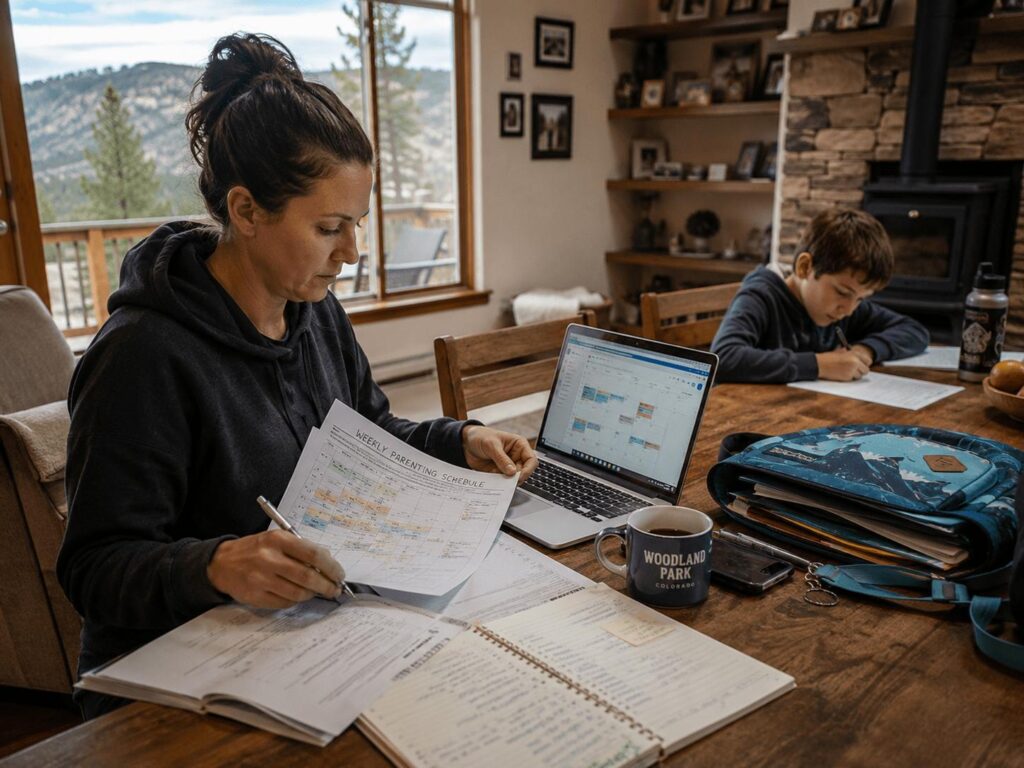
Teller County parenting cases can be different because local geography and daily logistics often matter. A parent in Woodland Park may not be far from Colorado Springs in miles, but winter weather, mountain roads, work schedules, and school start times can make parenting exchanges more difficult than they appear. These details can affect the child’s routine and the practicality of a proposed schedule.
School location can also become a major issue. If one parent wants the child to remain in Woodland Park schools and the other parent wants a different district, the court may need to consider stability, commute time, academic support, friendships, extracurricular activities, the child’s age, and each parent’s ability to support the child’s routine. A school dispute is often about much more than a building.
Small-community dynamics can also shape conflict. Parents may see each other at school events, youth sports, stores, churches, or community activities. Clear orders can help reduce unnecessary contact, prevent misunderstandings, and support healthier co-parenting when ongoing interaction is unavoidable.
WHO PARENTAL RESPONSIBILITIES CASES APPLY TO
Parental responsibility issues can apply to married parents, unmarried parents, divorcing parents, legally separated parents, and parents who already have orders but need modification or enforcement. APR may also come up when a parent wants to relocate, change schools, restrict parenting time, or address safety concerns. The case type depends on the family’s legal status and current orders.
If parents are divorcing, parental responsibilities are usually handled as part of the divorce case. The firm’s Colorado Springs divorce lawyers page discusses divorce issues that may overlap with parenting time, decision-making responsibility, child support, and property matters. In divorce, parenting orders are often one part of a larger financial and family transition.
If parents were never married, APR may be handled through a separate parental responsibilities case. In these cases, the court may also need to protect parental rights and determine whether the biological father has legal standing. The court may need to address parenting time, decision-making responsibility, child support, and whether parents need to establish paternity. The firm’s parental responsibilities page is directly relevant for families trying to understand this type of case.
PARENTING TIME IS THE SCHEDULE
Parenting time is the part of parental responsibilities that explains when the child is with each parent. It may include weekdays, weekends, holidays, school breaks, summer vacation, transportation, exchanges, phone or video contact, and make-up time. A vague schedule often creates problems later.
Some families ask for joint custody in everyday language, even though Colorado law focuses on parenting time schedules. Others use a 2-2-5-5 schedule, an every-other-weekend schedule, or a custom plan based on work and school demands. For Woodland Park families, the best schedule may need to account for mountain travel and school-day realities.
A good parenting schedule should be specific enough to prevent unnecessary disputes. It should explain start times, end times, exchange locations, holiday priorities, vacation notice, and what happens if a parent is late. Specificity is not hostility; it is often how parents reduce future conflict.
DECISION-MAKING RESPONSIBILITY IS ABOUT MAJOR CHOICES
Decision-making responsibility concerns major decisions for the child. These may include education, medical care, mental health care, religion, and sometimes significant extracurricular or developmental issues. Decision-making can be joint, sole, or divided by subject, and many people refer to these arrangements as legal custody.
Joint decision-making can work when parents communicate well enough to share information, consider each other’s views, and make decisions for the child. It may not work when there is severe conflict, domestic violence, refusal to communicate, or a history of unilateral decision-making. The court must consider whether the arrangement is realistic and safe.
Sole decision-making does not necessarily mean the other parent has no parenting time. It means one parent has authority over certain major decisions. If you are asking for sole decision-making, sometimes called sole custody in plain language, or defending against that request, your evidence should explain why the proposed decision-making structure serves the child’s best interests.
SAFETY CONCERNS CAN CHANGE THE CASE
Safety concerns can significantly affect parental responsibilities. Domestic violence, child abuse, substance abuse, unsafe driving, serious mental health concerns, neglect, threats, or coercive control may affect parenting time, exchanges, communication, and decision-making. As of January 20, 2026, relocation requests must be evaluated with child safety as a priority. These concerns should be documented carefully.
In some cases, a parent may request restrictions, supervised parenting time, protected exchanges, or limits on communication. Protection orders may also overlap with APR cases. The firm’s protection order lawyers page discusses protective order issues that may intersect with family law cases.
If you are raising safety concerns, facts matter. Police reports, protection orders, messages, medical records, school concerns, witness statements, photographs, and incident timelines may all be relevant. If you are responding to allegations, you should also gather organized evidence and address the child’s well-being rather than relying only on denial.
PARENTAL RESPONSIBILITIES ISSUES AT A GLANCE
| Parental Responsibilities Issue | What It Means In Plain English | Documents Or Evidence That May Matter |
|---|---|---|
| Parenting Time | The schedule that explains when the child is with each parent. | School calendar, work schedules, transportation plans, overnight history, and prior orders. |
| Decision-Making Responsibility | Who makes major decisions about education, medical care, religion, and similar issues? Some parents still refer to this as legal custody. | Communication history, school records, medical records, decision history, and evidence of cooperation or conflict. |
| Holiday And Vacation Time | How parents divide holidays, birthdays, breaks, and travel. | Family traditions, travel plans, school breaks, extended family involvement, and prior holiday patterns. |
| Transportation And Exchanges | Where and how the child moves between parents. | Distance between homes, weather concerns, vehicle reliability, safety issues, and school location. |
| Safety Restrictions | Limits on parenting time or communication when safety is a serious concern. | Protection orders, police reports, treatment records, messages, witness information, and child welfare records. |
| Modification Or Enforcement | Changing an old order or addressing violations of an existing order; related issues can sometimes overlap, including child support arrangements. | Existing orders, violation logs, changed circumstances, messages, calendars, and child-related records. |
PRACTICAL STRATEGIES AFTER YOU UNDERSTAND THE ISSUES
Once you understand the main APR issues, the next step is preparation. You should not walk into mediation or court with only a general statement that you want more time or more control. You should have a child-focused proposal that explains how your plan works in real life.
Start by drafting a practical parenting schedule. Include school-day routines, weekends, holidays, transportation, snow days, summer breaks, extracurriculars, and phone contact. A complete plan helps the other parent, the mediator, or the court evaluate the details rather than guessing what you mean.
You should also organize evidence by issue. Keep school records separate from medical records, communication logs, calendars, safety documents, and financial information. A well-organized file can help your attorney identify strengths, risks, and gaps before deadlines arrive.
COMMON MISTAKES TO AVOID IN AN APR CASE
One common mistake is making the case about the parents instead of the child. The court usually wants to know how a proposed plan affects the child’s safety, stability, school routine, relationships, and development. Arguments focused only on adult frustration may not help.
Another mistake is using vague language in a parenting plan. Phrases like “reasonable time” or “as agreed” may sound cooperative, but they can create disputes if communication breaks down. Clear terms often prevent conflict.
A third mistake is ignoring child support. Parenting time and support are separate issues, but they often connect. The Colorado Judicial Branch provides a support calculation resource that may help parents understand how parenting time and financial information can affect support.
HOW CHILD SUPPORT CONNECTS TO PARENTAL RESPONSIBILITIES
Child support often comes up in APR cases because parenting time can affect the calculation. Income, overnights, health insurance, childcare costs, certain expenses, and financial support needs may all matter. The firm’s child support lawyer page discusses support issues that may need to be reviewed alongside parenting orders.
Parents should not design a parenting plan only to change support. The child’s best interests should come first. Once the schedule is realistic and child-focused, support can be calculated using accurate information, and the amount is not only formula-driven because it may also reflect the child’s standard of living before separation.
Clear child support arrangements can also reduce avoidable conflict between parents. A clear parenting plan, complete financial disclosures, and accurate calculations can reduce avoidable conflict. When support and parenting are handled together carefully, the final orders are often easier to follow.
WHEN PARENTAL RESPONSIBILITIES COME UP DURING DIVORCE
In divorce, parental responsibilities are usually handled as part of the larger case. The court may need to address parenting time, decision-making, child support, property division, maintenance, debt, and temporary orders. These issues can influence each other.
Temporary parenting orders may be needed while the divorce is pending. These orders can set a schedule, define decision-making, establish child support, and reduce conflict until final orders are entered. Temporary orders are not always the outcome, but they can shape the family’s routine during the case.
Your attorney should help you understand how the parenting plan fits with the broader divorce strategy. For example, school stability, housing, transportation, support, and the parents’ financial interests should be reviewed together when related divorce issues affect housing, taxes, or support. A parenting plan that ignores the financial or logistical picture may be difficult to follow.
WHEN PARENTAL RESPONSIBILITIES COME UP FOR UNMARRIED PARENTS
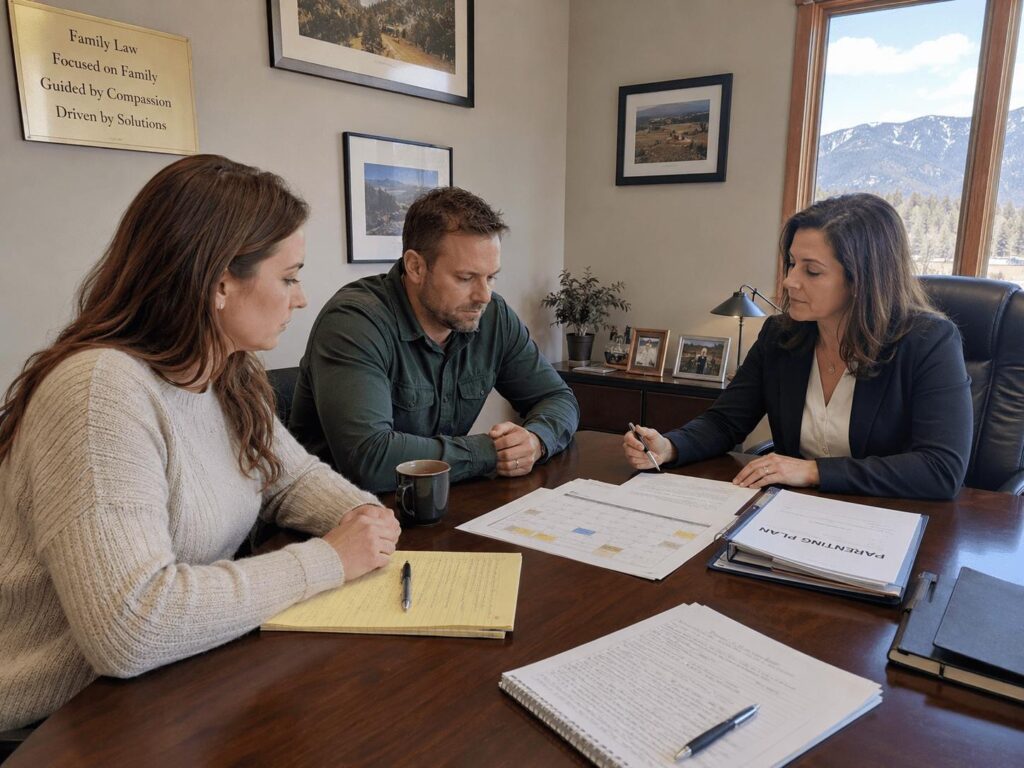
Unmarried mothers and fathers may need a parental responsibility case to establish clear parenting orders. Without court orders, disagreements over school, medical care, travel, holidays, and parenting time can become difficult to resolve. A court-approved parenting plan gives both parents and the child clearer expectations.
The Colorado Judicial Branch explains that parents can start or respond to a parental responsibility case to get a parenting plan. That plan can assign parental responsibility, create a parenting schedule, outline major decision-making, and address child support. The correct paperwork and process depend on the family’s situation.
Parentage may also need attention in some cases. If legal parentage is disputed or unclear, that can affect rights and responsibilities, including whether fathers can seek enforceable rights and responsibilities. An attorney can help identify whether parentage, APR, and support issues need to be addressed together.
MODIFICATION OF PARENTING TIME OR DECISION-MAKING
Parental responsibility orders sometimes need to change. A child may start a new school, a parent may move, work schedules may change, safety concerns may develop, or an old schedule may no longer fit the child’s needs. The process depends on what part of the order needs modification and whether your child’s needs or your current custody arrangements have changed in practical day-to-day ways.
The Colorado Judicial Branch provides information about how to change parenting time. Modification rules may differ depending on whether the requested change is minor, major, related to safety, or connected to the child’s primary residence. Timing and evidence can matter.
Parents should be careful not to rely solely on informal changes. If you and the other parent agree to a long-term change to your written parenting plan, sometimes called a custody agreement, it is often safer to put it in writing and seek court approval. Otherwise, the old order may still be enforceable.
ENFORCEMENT OF PARENTAL RESPONSIBILITIES ORDERS
If one parent is not following the parenting plan, enforcement may be necessary. Problems may include missed exchanges, denied parenting time, late returns, refusal to share school or medical information, unilateral decisions, or failure to follow communication rules. The right response depends on the facts and the existing order.
Documentation is important. Keep a clear log of missed time, late exchanges, messages, school issues, denied calls, and any attempts to resolve the problem. Avoid emotional commentary that distracts from the issue.
Do not respond to one violation by creating another violation. If the other parent breaks the order, the best response is usually to document the issue and use the proper legal process. Courts often care about whether each parent respects orders even during conflict.
HOW MEDIATION FITS INTO APR CASES
Mediation is common in Colorado family law cases. It gives parents a chance to resolve disputes with the help of a neutral mediator. Mediation may address parenting schedules, decision-making, holidays, transportation, support, communication, and future dispute resolution.
The Colorado Judicial Branch provides mediation information for court users. Mediation can be helpful when both parents have enough information to negotiate and are willing to focus on the child’s needs. Safety concerns may affect whether mediation is appropriate or how it should be structured.
Before mediation, bring a proposed parenting plan, calendars, school information, childcare information, transportation details, and a list of unresolved issues. Know what matters most and where you may have flexibility. A prepared mediation can save time and reduce conflict.
WHAT TO EXPECT IN A PARENTAL RESPONSIBILITIES HEARING
If parents cannot agree, the court may hold a hearing. At a hearing, each parent may testify, present documents, call witnesses, and ask the court to enter parenting orders. The judge or magistrate will focus on the child’s best interests and the evidence presented.
Helpful evidence may include school records, medical records, parenting calendars, communication history, transportation plans, safety documents, and testimony about the child’s needs. The court is usually more helped by specific facts than by broad accusations. Your attorney should help organize exhibits and prepare your testimony.
You should also be ready to explain why your proposed plan is workable. It is not enough to say you want equal time, sole decision-making, or a different school. You should be able to explain how the proposal supports the child’s stability, safety, education, health, and relationship with both parents when appropriate.
FREQUENTLY ASKED QUESTIONS ABOUT PARENTAL RESPONSIBILITIES IN WOODLAND PARK, COLORADO
WHAT DOES THE ALLOCATION OF PARENTAL RESPONSIBILITIES MEAN IN COLORADO?
Allocation of parental responsibilities is Colorado’s legal term for the rights and duties parents have for their children. It usually includes parenting time and decision-making responsibility. Parenting time is the schedule, and decision-making responsibility covers major choices such as education, medical care, and religion.
Are parental responsibilities the same as custody?
It is similar to what many people still refer to as custody. Many parents still use the term “child custody,” but Colorado uses different legal language focused on parenting time and decision-making responsibilities. Instead of focusing on custody labels, Colorado courts focus on parenting time, decision-making responsibility, and the child’s best interests. The exact orders depend on the facts of the case.
HOW DOES A COLORADO COURT DECIDE PARENTING TIME?
The court decides parenting time based on the child’s best interests. The court may consider safety, the child’s needs, the child’s relationship with each parent, school adjustment, parenting history, distance between homes, and each parent’s ability to support the child. Specific evidence is usually more helpful than general complaints.
CAN DECISION-MAKING RESPONSIBILITY BE SHARED?
Yes. Decision-making responsibility can be joint, sole, or divided by topic. Joint decision-making may work when parents can communicate and cooperate. Sole or divided decision-making may be considered when conflict, safety concerns, or repeated deadlocks make joint decisions unrealistic.
WHAT DOCUMENTS SHOULD I BRING TO AN APR CONSULTATION?
Bring any existing court orders, parenting plans, school records, medical records, communication records, calendars, police reports, protection orders, childcare records, and child support information. The first meeting may serve as an initial consultation to help our law office review the legal matter efficiently. If the case involves safety concerns, bring specific documentation. Organized records can make the consultation more useful.
CAN A PARENTAL RESPONSIBILITIES ORDER BE CHANGED LATER?
Yes, but the process and standard depend on what you want to change. Parenting time, decision-making, relocation, restrictions, and enforcement issues may involve different requirements. You should get legal guidance before relying on informal changes or assuming the current order no longer matters.
PARENTAL RESPONSIBILITIES DECISIONS DESERVE CAREFUL ATTENTION
Parental responsibility orders affect your child’s daily life, school routine, medical care, holidays, communication, and long-term stability. In Woodland Park and Teller County, those orders should also account for local facts such as mountain travel, weather, school location, work schedules, and safety concerns. A parenting plan that ignores those details may be harder to follow and easier to fight about.
Moran, Allen & Associates Family Law is a family law firm serving Woodland Park and Teller County that can help families understand how parental responsibilities fit into divorce, custody, child support, modification, enforcement, and protection order matters. A strong case starts with accurate information, organized documents, and a realistic understanding of the legal process. You do not need to have all the answers before asking for help.
If parental responsibilities are part of your family law case, early review can help you avoid mistakes and prepare for negotiation, mediation, or court. Contact us today to focus on your child’s safety, stability, relationships, and a workable path forward.